Centennial Ride 2026
Who We’re Riding For
Every mile of this ride raises awareness and funds for free mental health care for Kansans in need.
Hope Through Strengths Clinic — AMPP Lab, University of Kansas
The Applied Masculinities and Positive Psychology (AMPP) Lab at KU provides free online therapy to adults across Kansas experiencing anxiety, depression, and general life stress. Rather than focusing solely on symptoms, their approach helps clients identify their strengths, build hope, and cultivate lasting positive change.
Each client receives a structured 10-session protocol via secure telehealth — removing barriers of distance, transportation, and cost. To date, the clinic has delivered more than 3,000 hours of free therapy to over 400 individuals across 48 Kansas counties. 70% of clients show clinically significant improvement within eight weeks.
Every therapist is a master’s or doctoral student in KU’s Counseling Psychology program, supervised by licensed psychologists. More than 80 clinicians have trained through this model — carrying a strength-based framework into careers across Kansas and beyond. The vision is to build on this proven foundation and expand the Hope Through Strengths model into a nationwide program — bringing free, evidence-based mental health care to communities far beyond Kansas.
Your Support Makes It Possible
Every dollar goes directly toward the telehealth and assessment platforms that keep care free.
Learn more: ampp.ku.edu • KWCH 12 News Coverage
The Ride
In 2026, Route 66 turns 100 years old. To mark this centennial, I’m riding the full length of the Mother Road by bicycle — solo, from the Santa Monica Pier in California to the end of the line at Lake Shore Drive in Chicago, Illinois. Over 2,500 miles of American history, roadside legend, and open highway, covered on two wheels and fueled by determination.
This isn’t my first ultra-distance ride. I’ve raced in Race Across America (RAAM) and ridden solo from Cannon Falls, Minnesota to Las Vegas — 1,815 miles in 9.5 days — all to raise money and awareness for causes close to my heart. This time, the route itself is the story.
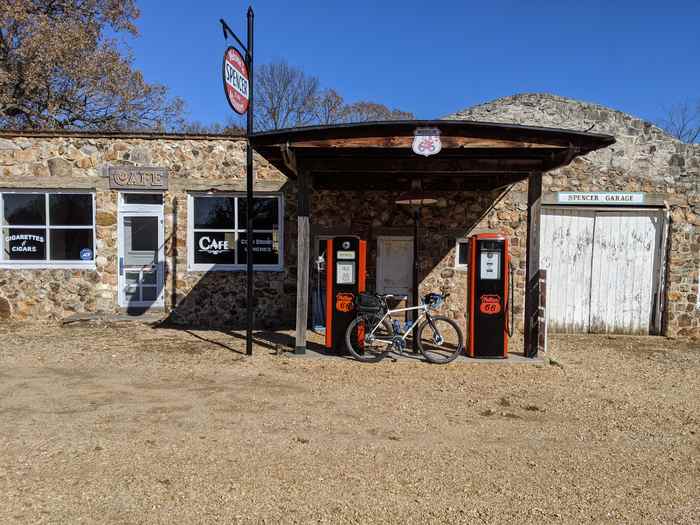
A classic Route 66 roadside stop — the kind of scene that defined an era of American travel.
A Hundred Years of the Mother Road
The story of Route 66 begins with a telegram. On April 30, 1926, Cyrus Avery — a Tulsa businessman and key figure in the American Association of State Highway Officials — sent a telegram proposing that the new highway connecting Chicago to Los Angeles be designated by the number 66. The number was available, memorable, and easy to say. That telegram set in motion what would become the most famous road in American history.
On November 11, 1926, the federal highway system was officially established, and U.S. Route 66 was among the original highways designated. Stretching through eight states — Illinois, Missouri, Kansas, Oklahoma, Texas, New Mexico, Arizona, and California — it connected the industrial heartland of Chicago to the Pacific coast. One of the first highways to be fully paved, completed in 1938, it became the lifeline of mid-century America.
During the Dust Bowl of the 1930s, Route 66 became the primary path of migration for hundreds of thousands of families fleeing the devastated Great Plains. John Steinbeck immortalized this exodus in The Grapes of Wrath, calling it “the Mother Road — the road of flight.” After World War II it transformed again: motels, diners, neon-lit diners and roadside landmarks sprang up along its length, and Bobby Troup’s 1946 song “(Get Your Kicks on) Route 66” cemented its place in American pop culture.
The Interstate Highway Act of 1956 eventually bypassed the towns Route 66 had sustained, and on June 27, 1985 the road was officially decommissioned. But it refused to die. In 2026, communities all along the route celebrate its centennial — 100 years of the highway that defined American road culture.
The Route
Santa Monica, CA → Chicago, IL — Following Historic Route 66
Live Tracking
Updated every 10 minutes via Garmin inReach satellite tracker
Trip Timeline
Estimated pace: ~14 mph • 10–12 hours per day • ~140–168 miles per day • ~17 days total
Santa Monica, CA
Depart from the Santa Monica Pier on the 100th anniversary of Cyrus Avery’s telegram. Ride east through LA, Pasadena, and into San Bernardino (~100 miles).
Mojave Desert & Needles, CA
Cross the Mojave through Barstow and push to Needles at the California/Arizona border. Flat desert miles at speed (~300 miles).
Arizona — Oatman to Flagstaff
Climb through Oatman and Kingman, then ascend to Flagstaff at 7,000 ft elevation — the biggest climbing challenge of the route (~280 miles).
New Mexico — Gallup to Albuquerque
Cross the New Mexico high desert through Gallup and Grants into Albuquerque. Rolling terrain across the Continental Divide (~300 miles).
Texas Panhandle — Santa Rosa to Amarillo
Flat, windswept miles across the Texas Panhandle. Cadillac Ranch near Amarillo. Classic Route 66 country (~300 miles).
Oklahoma — OKC to Tulsa
Through Oklahoma City and on to Tulsa. The heartland stretch, where Route 66 culture — diners, drive-ins, and neon — is most alive (~280 miles).
Missouri — Joplin to St. Louis
Through Joplin, Springfield (birthplace of Route 66), and across to St. Louis and the Gateway Arch (~300 miles).
Illinois & Chicago Finish
The final push through Springfield, IL (Lincoln country) and into Chicago. Finish at Lake Shore Drive — the eastern terminus of Route 66 (~280 miles).
Photos & Videos
Snapshots and footage for the whole journey
Click on the button below to view the journey images
Photos, videos & daily dispatches — organized by segment
Why I Ride
I haven’t always been a cyclist. In 2005, I weighed over 300 pounds, had high blood pressure, early signs of diabetes, and had just quit smoking three packs a day. In 2006, I bought a hybrid bike and started riding every day. By 2007, I’d lost 100 pounds. Cycling didn’t just change my body — it gave me my life back.
Since then, I’ve averaged over 11,500 miles a year on a bike. In 2015, I rode solo from my home in Cannon Falls, Minnesota to Las Vegas — 1,815 miles in 9.5 days, through 25+ mph headwinds for seven of those days. In 2016, five months after prostate cancer surgery, I rode from Las Vegas back to Minnesota (2,020 miles in approximately 7 days) to raise money for Suicide Awareness Voices of Education (SAVE). In 2017, I raced in Race Across America solo — 3,000 miles coast to coast.
I’ve experienced the worst that ultra-distance cycling can throw at you: Shermer’s neck, sleep-deprivation hallucinations, hand paralysis, saddle sores severe enough to require medical attention. I’ve ridden through all of it, because no amount of suffering on a bike comes close to what someone in crisis feels, or what their family endures if they don’t get help.
I ride because I was given a second chance, and I believe in paying that forward. This Route 66 centennial ride continues that mission. If my story helps even one person reach out for help, or motivates one donation to support those in need, every mile will have been worth it.
988 Suicide & Crisis Lifeline: Call or text 988
Crisis Text Line: Text HOME to 741741